
Why Tech Software Stocks Could Snap Back Faster Than Anyone Expects
Hedge funds have placed $24 billion on tech software stocks to keep falling. The setup for a sharp reversal is quietly building.


Some of the biggest tech stocks have barely moved in two years. In the same window, the NASDAQ exploded up by 70%, while software in the technology sector went down by about 8%.
A gap of almost 80% between the NASDAQ and software tech companies is rare in 2026. And rare gaps tend to close hard.
Key Takeaways
Hedge funds have placed about $24 billion in short bets against tech software stocks for two years.
The NASDAQ ran 70% in two years while the software tech sector dropped roughly 8%.
Positioning in the information technology sector is the most lopsided Felix Prehn has seen in years.
Felix points to 3 tech stocks to watch, and the IGV ETF holding 110 software companies.

The $24 Billion Bet Against Tech Stocks
Hedge funds have made about $24 billion betting that tech software stocks would fall. The bet has been running for two years now. And the narrative driving it is quite simple: AI is going to kill software companies.
If you’re an investor with exposure to technology stocks in the software bucket, you’ve likely felt the pain.
The NASDAQ has delivered roughly 70%, while the biggest software companies in the information technology sector have dropped about 8%. So a $10,000 stake in tech software stocks is now closer to $9,000, whereas the same $10,000 in the NASDAQ is closer to $17,000.
The gap between the wider tech sector and software tech stocks is what makes 2026 unusual. And every investor watching the stock market right now should be asking why the valuation gap got so wide.
Why The AI Narrative Is Hurting Software Companies
Artificial intelligence builds software faster and cheaper, so software companies are toast. Wall Street ran with it. Hedge funds piled $24 billion onto the short side. And the fear became the trade.
But check your own behaviour as a consumer: have you cancelled your Microsoft subscription? Free alternatives like Google Docs exist, yet enterprises keep paying Microsoft for the same products and services.
The software stays embedded in 100,000-employee organisations, keeping the cash flowing. The subscriptions are rarely getting cut, if at all.
Cybersecurity Spending Keeps Growing. Here’s Why
Cybersecurity spending isn’t dropping either. If anything, companies are being pushed to spend more because the use of AI has somehow increased the volume of cyberattacks.
Cybersecurity is a non-negotiable line item for any enterprise, which protects future growth across the technology sector.
The Rubber Band Behind The Tech Stock Snap
If the AI-kills-software story is the fuel, lopsided positioning is the gunpowder. Here’s how to picture the setup.
Why Lopsided Positioning Matters For Investors
Picture a boat for a moment. If everyone on board runs to one side, the whole boat tips over. Wall Street positioning works in pretty much the same way.
Right now, way more money is betting tech software stocks will fall than rise. And the more crowded one side gets, the higher the odds of a violent flip back the other way.
For an investor scanning the best tech stocks to buy in 2026, lopsided positioning is one of the loudest signals an analyst can spot. Volatility tends to follow whenever the crowd leans too far one way.
The Rubber Band Effect On Tech Stocks
Now stretch a rubber band far in one direction. Pressure builds the further it gets pulled. Eventually, the rubber band snaps back, harder than the original stretch.
Markets behave in pretty much the same way. Extreme crowding builds pressure, and a small piece of positive news can be enough to release it.
For software tech stocks, the trigger could come from a single strong earnings print, a positive policy headline, or a news item that breaks the AI-kills-software story.
Earnings season is where a lot of the pressure tends to release, and an earnings surprise could reset a whole sector’s valuation overnight.
The 3 Signals Pros And Analysts Watch In 2026
Felix laid out 3 specific steps pros and analysts use to spot the moment before the snap:
Positioning: how crowded the short side is. Software is now at an extreme, which often points to an undervalued setup.
The crack: a price level breaking after the bears expected the stock price to stay below it. The IGV software ETF bounced near $74 and recovered above its 50-day moving average.
Forced buying: short sellers buying back the stock to close their losing bets, which then adds even more fuel to the move.
Put together, the setup lines up neatly with a classic short squeeze pattern in the tech sector. Learn a trading system for free inside Felix Prehn’s live masterclass, with no card and no catch.
Forced Buying And The Avis Lesson For Software Stocks
Avis is the cleanest recent example of how a squeeze plays out in real time on the stock market.
Avis ran up hard, then crashed. Short sellers piled in on the way down, and as the stock turned back up, their losses started to mount. The only way to close out a short position is to buy the stock back.
The forced buying ended up driving Avis up roughly 400%. The car rental fundamentals didn’t suddenly change.
The mechanical buying did the work. A short squeeze is more about risk management than enthusiasm, and it can move faster than any analyst expects.
3 Tech Stocks To Watch In The Software Squeeze Zone
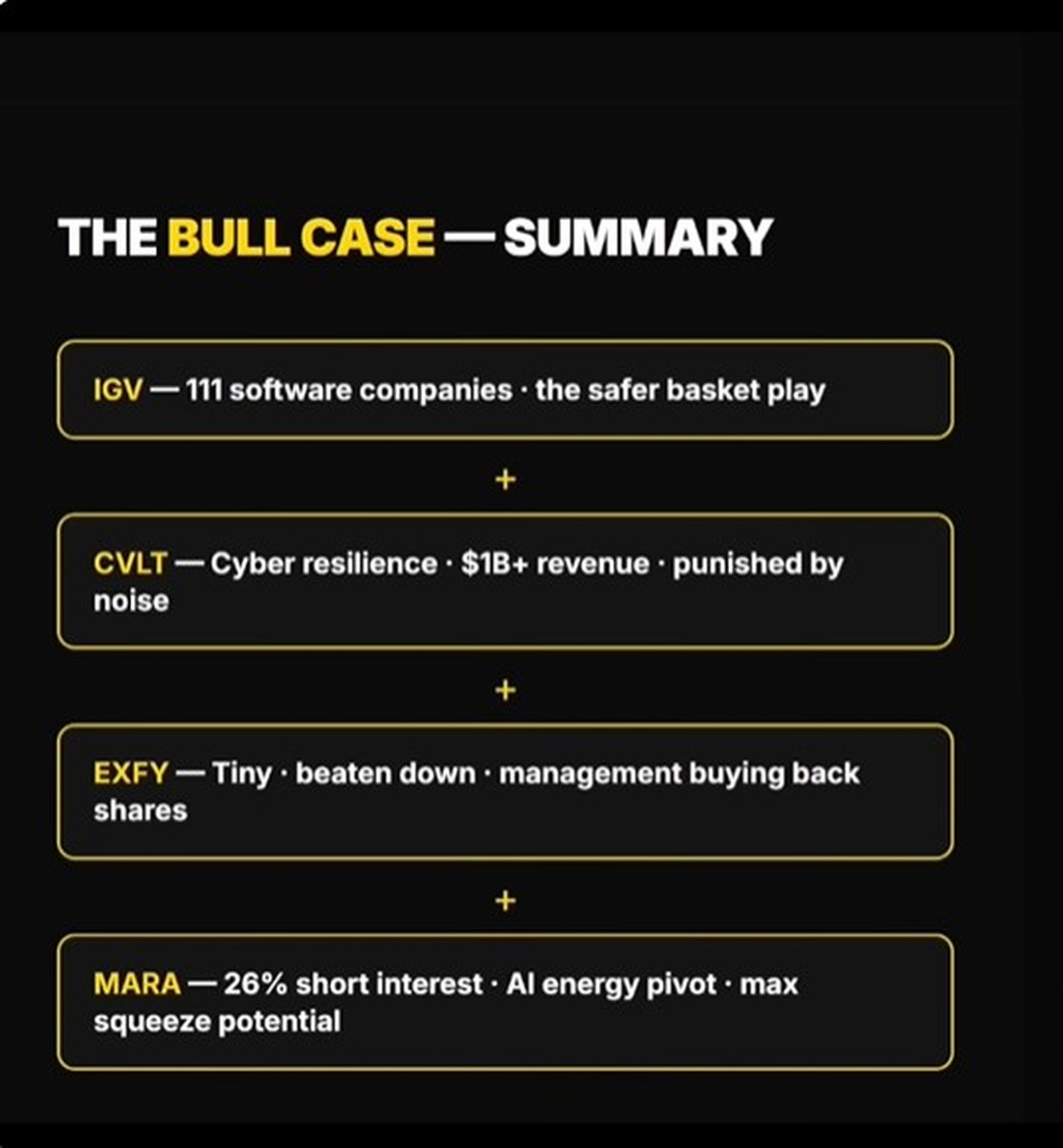
Felix flagged 3 tech stocks to buy attention, worth watching as an investor, with no buy rating attached:
Commvault Systems (CVLT): A cybersecurity and data protection company in the information technology sector. Over $1 billion in revenue, with revenue growth of 19% a year.
Enterprise clients in many industries, partnered with CrowdStrike, recently acquired an AI data security company. The stock price is down about 60%, but is now turning back up.
Expensify (EXFY): Cloud-based software for expense management and corporate cards. Down roughly 97% from a $50 peak.
Management has run a $25 million share buyback, and AI assistants like ChatGPT can now plug directly into the expense data. Tiny, speculative, and carrying very high short interest.
Mara Holdings (MARA): Formerly Marathon Digital, down about 83%. Over a quarter of the tradable shares are sold short. The company is pivoting from Bitcoin mining into AI data center infrastructure through the Long Ridge Energy acquisition.
The IGV ETF Route For Tech Sector Investors
For one-click exposure to the tech sector, the IGV ETF holds 110 leading software companies, including Microsoft, Oracle, Palo Alto, Palantir, and CrowdStrike.
One ticker, a wide slice of infrastructure software and cybersecurity names, and a simple way to diversify in the technology sector.
The buy-and-hold investment strategy does not quite work everywhere anymore in 2026.
Nokia held the crown, then lost it. Blackberry held it, then lost it too. Cisco was the most exciting software company around, and the same story played out. The money rotates from sector to sector faster every cycle.
The real skill an investor needs now is reading where the money is likely to hop next in the technology sector. Reduce the risk of bad decisions by learning the framework Felix uses every week inside the free masterclass.
FAQs
How did Felix do on his oil trade before the 2026 tech sector rotation?
Felix is up roughly 60% on his oil position. The S&P 500 moved only about 9% in the same window. So roughly 5x the market return.
What signal does Felix track to spot rotation between sectors in 2026?
He watches where the institutional money hops from bucket to bucket. The big money rotates between sectors faster than ever, and the pace keeps accelerating.
Does buy-and-hold still work for technology stocks and the S&P 500?
Buy-and-hold still works for an S&P 500 investor with a long-term growth runway. For single tech stocks or narrow sector funds, the old approach tends to fall short.
What does Felix mean by IPO summer for tech companies in 2026?
Companies sidelined for years are now preparing to list. SpaceX is one of many. Felix sees a 5-year wealth cycle historically kicking off after a wave of major IPOs, with fresh growth opportunities for the early investor.
Why does Felix compare top tech stocks to the 2020 IPO winners?
Airbnb, Coinbase, Roblox, and Rivian delivered 10x moves for early investors. The pattern of growth potential tends to rhyme every 5 to 10 years.
What chart pattern matters most for tech stocks right now?
The inverse head and shoulders. Higher lows stacking up after a deep drop. Felix sees the shape forming on Mara Holdings.
Why does Felix say Wall Street stopped caring about quality in tech companies?
Profits, management, and earnings growth all take a back seat now. Momentum is what drives the buying. The money simply rotates from sector to sector chasing it.
DISCLAIMER: The content is for informational and educational purposes only. It does not constitute and should not be construed as financial or investment advice or an offer to purchase or sell securities. The content is not personalized or tailored to a specific person or group of persons, nor to their personal investment or financial needs.